


One of the first questions people ask after a serious car accident is:
"How long will it take before I receive my settlement?"
It's an understandable concern. Medical bills begin arriving almost immediately. You may be unable to work, your vehicle may need repairs or replacement, and the financial stress of an unexpected accident can quickly become overwhelming.
Unfortunately, there isn't a simple answer.
Some Colorado car accident claims resolve in a matter of months, while others take a year or longer. The timeline depends on many factors, including the severity of your injuries, whether liability is disputed, the insurance company's willingness to negotiate fairly, and whether a lawsuit becomes necessary.
Although waiting can be frustrating, settling too quickly can be just as costly. Accepting an offer before you fully understand your injuries or future medical needs may leave you paying expenses out of your own pocket long after your case has closed.
At Chris Parks Law, we help accident victims throughout Boulder and surrounding Colorado communities understand the settlement process, avoid common mistakes, and pursue compensation that reflects the true impact of their injuries.
This guide explains what affects settlement timelines, why every case is different, and what you can do to help your claim move forward while protecting your right to fair compensation.
Most Colorado car accident settlements take several months to more than a year, depending on the circumstances. Minor injury claims with clear liability may resolve relatively quickly, while accidents involving serious injuries, disputed fault, ongoing medical treatment, or litigation often require significantly more time. In most cases, reaching the right settlement is more important than reaching a fast settlement.
What You Need to Know
Many people assume there is an "average" settlement timeline.
In reality, no two personal injury claims are exactly alike.
Imagine two drivers involved in separate rear-end collisions on the same day.
One driver experiences minor soreness, receives a medical evaluation, completes several weeks of physical therapy, and fully recovers.
The other suffers a traumatic brain injury requiring surgery, months of rehabilitation, and ongoing neurological treatment.
Although both accidents occurred under similar circumstances, the settlement timelines could differ by many months—or even years.
The reason is simple:
Insurance companies need sufficient information before they can accurately evaluate a claim.
When serious injuries are involved, that information often isn't available immediately.
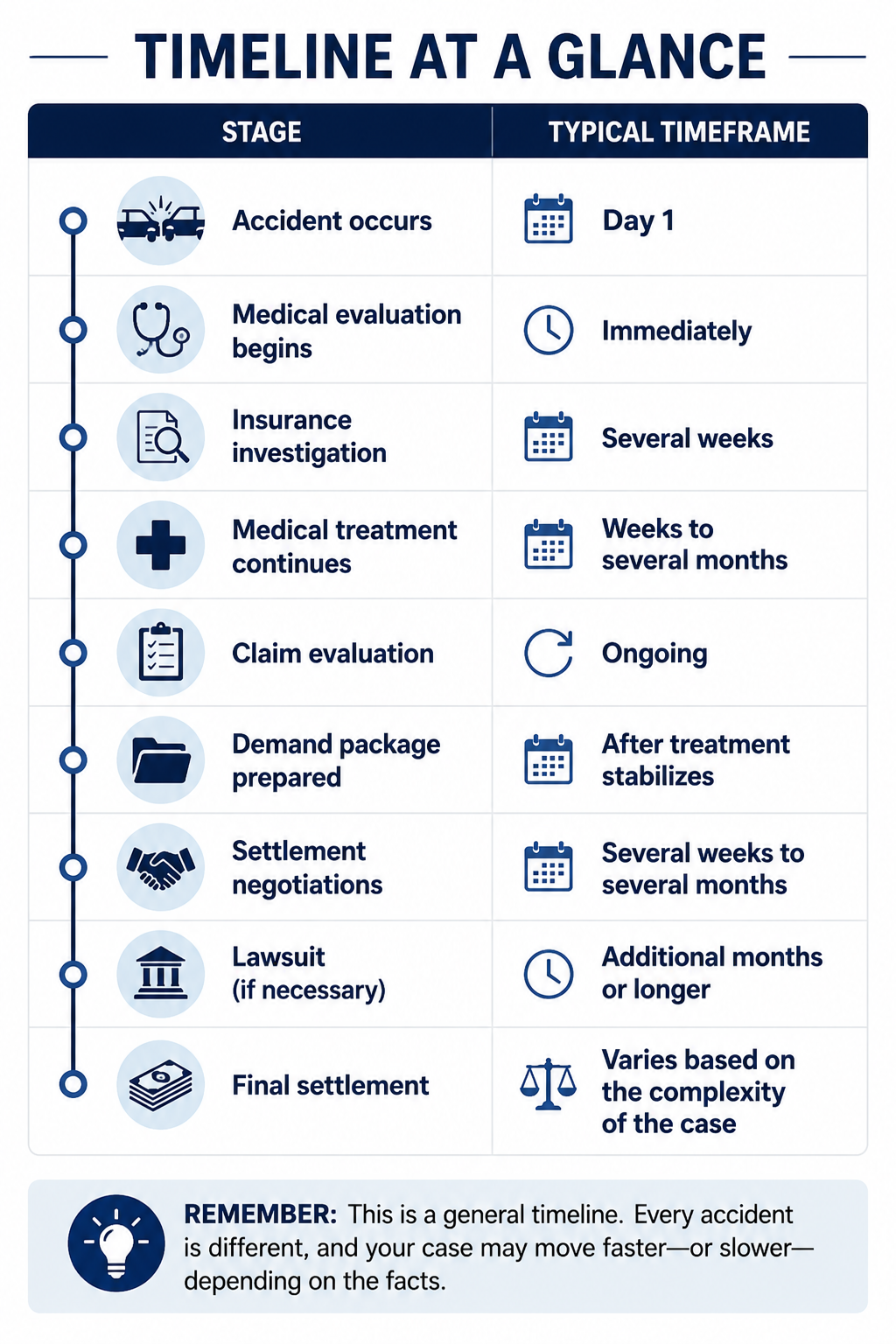
Although every claim is unique, most Colorado car accident settlements follow a similar progression.
Immediately after the collision, several important things begin happening simultaneously.
Medical treatment begins.
Insurance claims are opened.
Evidence starts disappearing.
Witness memories begin fading.
This is why documenting the accident early can have a significant impact on your claim.
Once a claim is reported, the insurance company assigns an adjuster to investigate.
The adjuster typically reviews:
Their first objective is determining liability.
Only after understanding who caused the accident can they begin evaluating compensation.
This stage often takes longer than people expect.
Depending on your injuries, treatment may involve:
Your attorney generally wants a clear understanding of your medical condition before serious settlement discussions begin.
That doesn't necessarily mean waiting until every appointment is complete—but it does mean understanding your prognosis and expected future treatment.
While you're recovering, your legal team is gathering documentation to calculate the full value of your claim.
This includes both financial losses and the ways the accident has affected your daily life.
Examples include:
This process takes time because your attorney wants to understand not only what the accident has already cost you—but what it may continue to cost you in the future.
Every case has unique circumstances, but several factors consistently influence how long negotiations take.
Generally speaking, the more serious the injury, the longer the claim.
That isn't because insurance companies intentionally delay every serious case.
Rather, serious injuries often require months of treatment before physicians can determine:
Without this information, accurately valuing a claim becomes extremely difficult.
If everyone agrees who caused the accident, negotiations can often begin sooner.
If liability is disputed, additional investigation may be necessary.
Examples include:
Resolving these disputes naturally adds time to the process.
Some insurance companies respond promptly.
Others request repeated documentation, conduct lengthy reviews, or dispute portions of the claim before making meaningful settlement offers.
Every additional request or disagreement may extend negotiations.
One of the most important milestones in many personal injury claims is reaching Maximum Medical Improvement (MMI) or having a reliable understanding of your long-term prognosis.
Until your physicians understand your expected recovery, it can be difficult to determine:
Settling before this point may result in compensation that doesn't fully reflect the impact of your injuries.
Larger claims generally receive greater scrutiny.
Insurance companies often require additional reviews, supervisory approval, or consultation with defense counsel before extending significant settlement offers.
This additional evaluation can increase the overall timeline.
After weeks or months of medical appointments, it's natural to want the process to end.
However, a fast settlement isn't always a good settlement.
Imagine accepting compensation six weeks after an accident because your injuries seem relatively minor.
Several months later, ongoing pain leads to an MRI revealing a herniated disc requiring surgery.
Unfortunately, if you've already signed a settlement agreement, you generally cannot reopen your claim simply because your injuries turned out to be more serious than initially believed.
This is one of the primary reasons experienced personal injury attorneys often recommend patience.
Understanding the full extent of your injuries helps ensure that settlement negotiations reflect your future—not just your past.
"One of the biggest misconceptions about personal injury claims is that faster is always better. Our responsibility is helping clients understand the long-term impact of their injuries before making permanent decisions. A settlement should provide peace of mind for the future—not create new financial burdens because important damages weren't yet known."
— Chris Parks, Attorney at Law
Once your medical condition is better understood and your attorney has completed a comprehensive evaluation of your damages, the next phase of your case focuses on settlement negotiations with the insurance company.
While many claims resolve through negotiation, others involve delays, disputed liability, or litigation before reaching a fair outcome.
In Part 2, we'll examine how insurance companies evaluate settlement demands, common tactics that delay negotiations, why serious injury cases often take longer, the biggest mistakes accident victims make, answers to the most frequently asked questions, and what you can do to protect the value of your Colorado car accident claim.


